
Reflection on National Read a Book Day
Part 1: Standing on the Shoulders of Giants
Today, September 6th, marks National Read a Book Day—a day that invites us all to set aside time to read and reflect on the transformative power of knowledge. As I immerse myself in Parmy Olson’s compelling “Supremacy,” I’m reminded of my late professor at Howard University, Dr. Joseph R. Houchins, whose teachings about economic transformation resonate more powerfully today than ever before.
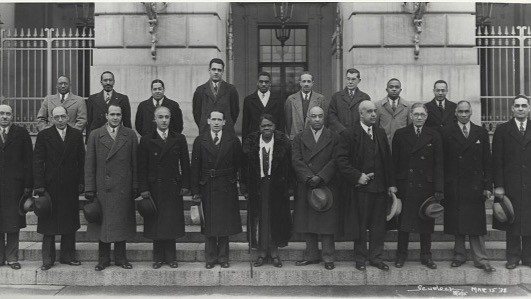
Dr. Joseph Roosevelt Houchins (1900-1990) was a pioneering labor economist who broke barriers as a member of FDR’s Black Cabinet, led the Division of Negro Affairs in the U.S. Department of Commerce, and served as chair and professor of economics at Howard University from 1961 to 1985. Joseph R. Houchins – Wikipedia His legacy extends far beyond these titles.

As I recall from Dr. Houchins, when I asked about the importance of reading books he said, “You have to read the books because the books were not written for us, and someday you might have to re-write the books.” This wisdom, shared in the early 1980s, speaks to a fundamental truth about knowledge, power, and transformation—one that takes on new meaning as artificial intelligence reshapes economic thought itself.
Part 2: The Numbers Tell a Story of Transformation
The economic data paints a stark picture of the transformation ahead:
📊 The AI Impact by the Numbers:
- Almost 40% of global employment is exposed to AI, with advanced economies seeing up to 50% job exposure IMFIEEE Spectrum
- Generative AI could enable labor productivity growth of 0.1 to 0.6% annually through 2040 The economic potential of generative AI: The next productivity frontier
- AI has the potential to deliver $13 trillion in additional global economic activity by 2030—about 16% higher cumulative GDP Preparing for Economic Singularity: A Guide for Finance Leaders | SPARK Blog | ADP
- 11.8 million U.S. workers may need to transition to different occupations by 2030 Are We Approaching an Economic Singularity? Information Technology and the Future of Economic Growth | NBER
AI’s projected economic impact over a decade

Part 3: Understanding the Economic Singularity
The concept of “economic singularity” represents more than just technological advancement—it signals a fundamental paradigm shift in how we understand economics itself.
Calum Chace defines economic singularity as the moment when AI “renders most of us unemployed, and indeed unemployable, because our jobs have been automated”—a point where normal economic rules cease to apply. Preparing for Economic Singularity: A Guide for Finance Leaders | SPARK Blog | ADP But this isn’t just about job displacement; it’s about reimagining the entire economic system.
Three Critical Paradigm Shifts:
- From Scarce to Abundant Intelligence: The Industrial Age made labor the scarce resource, driving up wages. Now, transformative AI could make human-level intelligence reproducible, fundamentally challenging traditional economic models. The Economics of Transformative AI | NBER
- From Gradual to Exponential Change: If the technological singularity occurs, economic output could double quarterly or even weekly, compared to the current 15-year doubling time. Technological singularity – Wikipedia
- From Capitalism to…?: The economic singularity threatens the end of capitalism itself, requiring an entirely new economic system. The Economic Singularity. Can a jobless future be wonderful?
Economic paradigm shifts from Agricultural Age → Industrial Age → AI Age

Part 4: Lessons from “Supremacy” – The Race That Changes Everything
Parmy Olson’s “Supremacy: AI, ChatGPT, and the Race that Will Change the World” (2024 Financial Times Business Book of the Year) chronicles the battle between OpenAI and DeepMind, revealing how idealism erodes in the face of commercial pressures. AmazonWikipedia
Key Insights for Business Leaders:
✓ Power Concentration: AI development isn’t meritocratic—it’s dictated by access to billions in funding, compute power, and exclusive resources controlled by tech monopolies Supremacy: AI, ChatGPT, and the Race that Will Change the World by Parmy Olson | Goodreads
✓ Speed of Disruption: ChatGPT reached 100 million users in just 2 months, demonstrating AI’s unprecedented adoption velocity
✓ Economic Transformation: The book shows “radical social and economic changes already being brought about by AI” with risks ranging from economic collapse to fundamental disruption of human purpose Supremacy: AI, ChatGPT, and the Race that Will Change the World by Parmy Olson, Hardcover | Barnes & Noble®
Part 5: Preparing for Tomorrow’s Economy – Action Items for Leaders
For Corporate Leaders:
- Rethink Business Models: Develop scenario plans comparing “business as usual” with transformative AI emerging in 5 or 20 years Technological singularity – Wikipedia
- Invest in Human Capital: Focus on skills that complement rather than compete with AI
- Plan for Disruption: Front-runners with strong IT bases could double their cash flow by 2030, while non-adopters might see 20% declines Preparing for Economic Singularity: A Guide for Finance Leaders | SPARK Blog | ADP
For Policymakers:
- Address Inequality: AI will likely worsen overall inequality—proactive policies including comprehensive social safety nets and retraining programs are crucial Economics Of The Singularity – IEEE Spectrum
- International Cooperation: Developing economies need support building digital infrastructure to avoid being left behind
- Regulatory Balance: Create frameworks that foster innovation while protecting workers and society
For Individuals:
- Continuous Learning: Skills necessary for work are expected to change 70% over the next five years Amazon.com: The Economic Singularity: Artificial intelligence and the death of capitalism: 9780993211645: Chace, Calum: Books
- Focus on Human-Centric Skills: Creativity, emotional intelligence, and complex problem-solving remain valuable
- Embrace Adaptation: Career transitions will become more frequent—flexibility is essential
