

Inclusive workforce development succeeds when skills development leads to real opportunity, not when training is treated as the finish line. For employers, educators, and community organizations serving underserved and underrepresented talent, the work is to build pathways that connect learning with workforce readiness, employment, advancement, entrepreneurship, and the changing demands of work. Dr. JoAnn Rolle, The AI Workforce Economist, brings an economist’s perspective to that challenge: access to training matters, but opportunity depends on whether people can build relevant capabilities, demonstrate what they know, and use those capabilities to move forward. Leaders can use workforce development as a bridge between talent potential and practical economic opportunity.
Inclusive Talent Development Requires More Than Access to Training
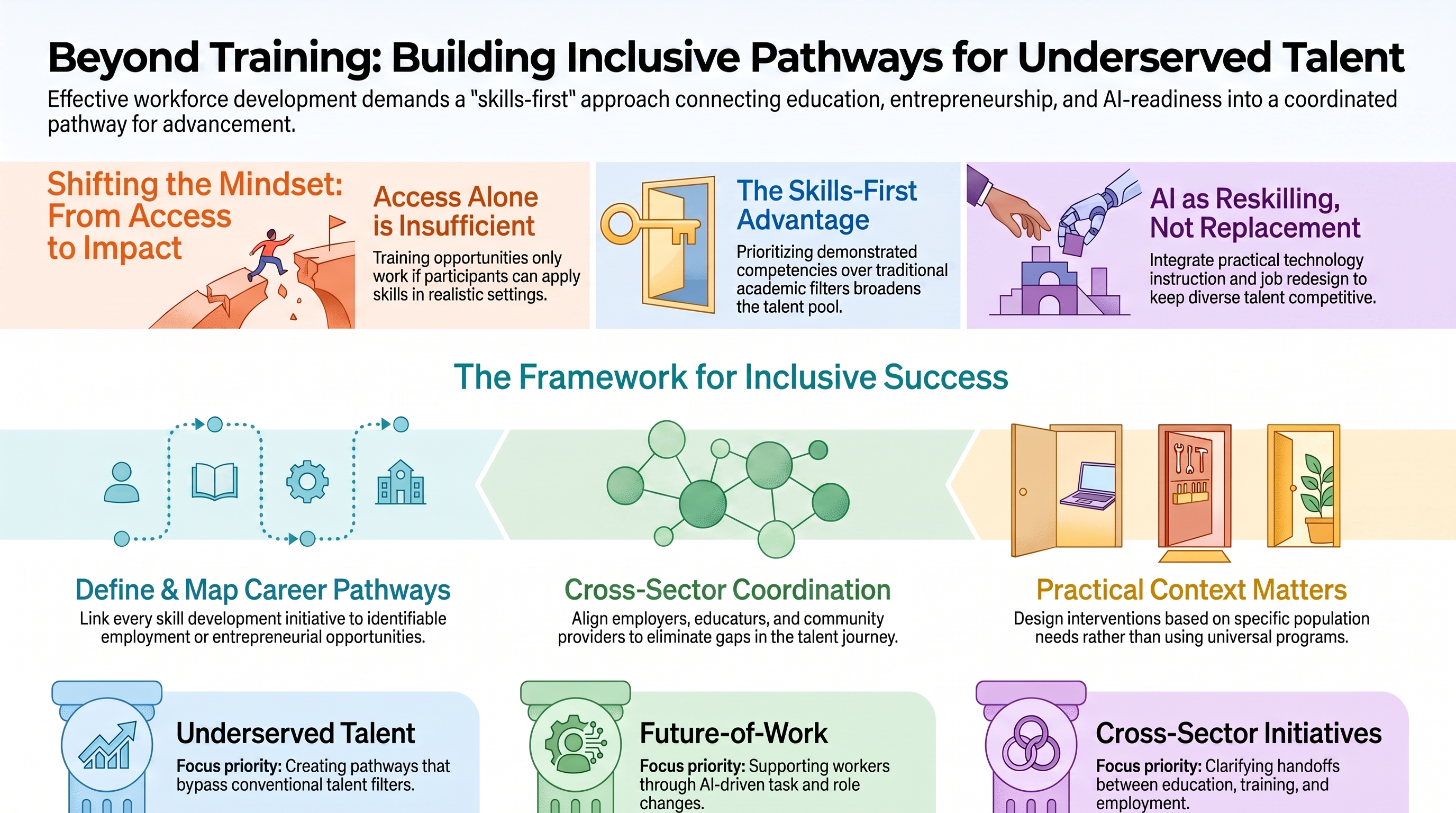
Training is useful only when people can turn learning into capability and capability into opportunity. A credible workforce development pathway therefore needs to do more than make courses available. Leaders should determine whether people can identify relevant skills, access appropriate development, practice what they learn, demonstrate their capabilities, and understand how those capabilities connect to employment, advancement, or entrepreneurship.
This is especially important when leaders are trying to expand opportunity for people whose capabilities may have been developed through nontraditional education, work, community, or entrepreneurial experiences. A skills-first approach gives organizations another way to identify potential by examining what people can do and what they can learn rather than relying only on conventional credentials.
Walmart’s Skills-First Workforce Initiative, for example, describes an employer-led effort to recognize skills regardless of work history or educational background and expand skills-first hiring and career pathways.
For workforce leaders, the practical test is not whether a program exists. It is whether people can see a pathway from development to opportunity and whether the organizations around them have built the connections necessary to make that pathway usable.
Workforce Development Should Connect Skills, Opportunity, and Organizational Change
Inclusive workforce development works best when leaders stop treating skills, access, employment, education, entrepreneurship, and technological change as separate problems. People experience them as one pathway. The organization should design them that way.
A practical starting point is to define the workforce problem before selecting a program. Leaders need to identify the capabilities that matter, understand where barriers are limiting opportunity, clarify which organizations are responsible for development, and examine the handoffs between education, training, employment, advancement, and entrepreneurship.
That approach turns workforce development from a collection of activities into a coordinated system. It gives employers, educators, community organizations, and workforce leaders a clearer basis for deciding where learning is needed, where partnerships are weak, where talent is being overlooked, and where the pathway to opportunity breaks down.
Technology must also be part of that design. A 2025 International Labour Organization analysis of generative AI and jobs identified clerical occupations among those with the highest exposure to generative AI and concluded that transformation of work is more likely than widespread replacement.
For workforce leaders, that means AI preparation should not be reduced to teaching people how to operate a tool. People also need opportunities to understand changing tasks, strengthen transferable capabilities, exercise judgment, and apply technology in ways that prepare them for work as it evolves.
Measure Workforce Development by the Strength of the Pathway
The number of courses delivered or participants enrolled does not tell leaders whether a workforce initiative is creating a usable pathway to opportunity. Evaluation should focus on how well the pieces of that pathway work together.
- Skills definition: Identify the capabilities relevant to current and emerging work so learners and organizations have a clearer basis for development and assessment.
- Access: Examine whether the pathway is realistically available to the people it is intended to serve, including individuals whose capabilities were developed through nontraditional routes.
- Learning application: Give participants meaningful opportunities to practice, demonstrate, and strengthen capabilities rather than relying only on instructional exposure.
- Career pathways: Connect skills development with identifiable employment, advancement, or entrepreneurial opportunities when those pathways are part of the organization’s objectives.
- Partnerships: Clarify how employers, workforce organizations, educational institutions, community-based organizations, and other partners contribute to the pathway.
- Adaptability: Build a development model that can respond as technology changes tasks, roles, and capability requirements.
- Leadership ownership: Establish who is responsible for coordinating priorities, communicating expectations, removing barriers, and sustaining the work beyond an individual program or training event.
These criteria shift attention from how much programming an organization delivers to whether people can move through a connected pathway from capability development to practical opportunity.
Coordination Closes the Gaps Between Learning and Opportunity
Workforce pathways can break down even when individual programs are strong. A person may complete training without knowing which capabilities employers value. An employer may have open opportunities without a reliable way to recognize talent developed through nontraditional routes. An educational institution may teach relevant capabilities without a clear connection to advancement or employment.
The problem in those cases is not necessarily the quality of the individual program. It is the quality of the connection between programs, organizations, and decisions.
Inclusive workforce development consulting can help leaders examine those handoffs. The work can include clarifying objectives, mapping the organizations involved, identifying capability gaps, and determining where education, employment, training, entrepreneurship, and technology need to connect more effectively.
Leaders also need to decide who owns those connections. A strong curriculum cannot carry the entire workforce strategy if employers, educators, workforce organizations, community partners, and internal leaders operate independently. Sustainable pathways require shared responsibility for moving people from development toward opportunity.
Where Inclusive Workforce Development Consulting Can Be Applied
Inclusive workforce development consulting is most useful when leaders need to connect talent development with a broader economic, organizational, or community objective. The specific design should follow the people being served and the opportunity the organization is trying to create.
- Underserved talent development: Build clearer connections between skills development, workforce readiness, and opportunity for people who may be overlooked by conventional talent systems.
- Workforce diversity and development: Examine how organizations identify, develop, prepare, and advance diverse talent as work requirements change.
- AI and future-of-work preparation: Help people understand changing tasks, strengthen relevant capabilities, and prepare to work effectively as technology becomes part of more roles.
- Education and training innovation: Connect learning with the workforce capabilities and economic opportunities it is intended to support.
- Entrepreneurship development: Include entrepreneurship as an opportunity pathway when business ownership, enterprise creation, or self-employment is relevant to the people and communities being served.
- Cross-sector workforce initiatives: Clarify how employers, educational institutions, workforce organizations, community partners, and other stakeholders can contribute to a shared pathway.
The emphasis will change by context. An employer may focus primarily on capabilities and advancement. A community workforce initiative may put more weight on access and partnerships. An educational organization may need to strengthen the connection between learning and economic opportunity. The pathway should be designed around the objective rather than forcing every population into the same program.
Inclusive Workforce Development Must Be Built for the People It Serves
There is no universal workforce development program because people do not begin from the same position, face the same barriers, or pursue the same opportunities. Effective design starts with context: who is being served, what capabilities they need, what prevents access, which organizations can help, and what meaningful progress should look like.
That principle matters for underserved and underrepresented talent. Inclusion should not mean inviting people into a pathway that was designed without their circumstances in mind. It should mean building practical routes through which people can develop capabilities, demonstrate value, gain access to opportunity, and continue moving forward as work changes.
For employers, educators, workforce organizations, and community leaders, the question is therefore not whether another program can be created. It is whether the existing pathway gives people a realistic way to move from potential to capability and from capability to opportunity.
Dr. Rolle Brings Direct Experience in Workforce Development and Underserved Communities
Dr. Rolle’s perspective is grounded in economics, technology, higher education, organizational leadership, entrepreneurship, and workforce development.
She holds a Ph.D. in Economics from Howard University. She served for ten years as Dean of the School of Business at Medgar Evers College (CUNY), where she founded the Entrepreneurship Experiential Learning Lab. She also served as Chief Academic Officer at LIM College and Chief Academic Officer at South Carolina State University.
Earlier in her career, Dr. Rolle served as an IBM executive from 1984 to 1993 and worked as an economist with the U.S. Department of Housing and Urban Development and the Federal Communications Commission.
Her international experience includes serving as Senior Economist at Tanzania Housing Bank on a World Bank-funded affordable housing project and as a Research Assistant at the World Bank.
Dr. Rolle is the author of Tech-Enabled Futures: Elevating Education in Underserved Areas (2024). Her proprietary frameworks include Tech-Enabled Futures™, The Rolle Method, and Bridge Capital. She is also a Past President of the National HBCU Business Deans Roundtable.
As The AI Workforce Economist, Dr. Rolle brings those experiences together around a practical economic question: how can organizations help people build the capabilities, access, and pathways they need to participate in changing work?
For leaders, those credentials are the starting point rather than the outcome. The value is in what the organization can do next: define the workforce challenge more precisely, identify the people being underserved, clarify the capabilities that matter, strengthen the pathway to opportunity, and build the partnerships required to sustain it.
Frequently Asked Questions
Who Is Inclusive Workforce Development Consulting For?
It is relevant to employers, educators, workforce organizations, community organizations, and leaders responsible for workforce development, education innovation, entrepreneurship, and future-of-work priorities. It is particularly useful when the objective is to create stronger skills and opportunity pathways for underserved or underrepresented talent.
What Does Inclusive Workforce Development Need to Address Beyond Training?
It should address the full pathway around training: which skills matter, whether people can access development, how they can practice and demonstrate capabilities, how learning connects to employment or advancement, which organizations share responsibility, and how the pathway can adapt as work changes.
How Does AI Affect Workforce Development for Underserved Talent?
AI can change tasks, skill requirements, and how work is organized. Workforce development should therefore help people build practical technology capabilities while also strengthening judgment, transferable skills, adaptability, and opportunities to apply what they learn. The objective is to prepare people to participate in changing work rather than treating technological change only as a threat.
What Should an Organization Evaluate Before Engaging a Workforce Development Consultant?
Leaders should clarify the workforce problem, population being served, capabilities required, barriers affecting access, desired opportunities, existing partnerships, internal ownership, and implementation constraints. They can then determine whether the consultant’s experience and approach fit the pathway the organization needs to build.
Build the Pathway, Not Just the Program
Inclusive workforce development should create movement, not merely participation. Training matters when people can use it to build capabilities, demonstrate value, gain access to opportunity, and keep progressing as work changes.
For leaders serving underserved talent, that means looking beyond individual programs and examining the entire pathway: skills, access, learning, application, partnerships, employment, advancement, entrepreneurship, and adaptation.
The practical next step is to identify where that pathway currently breaks. Determine which people are being missed, which capabilities matter most, where opportunity is disconnected from development, and which organizations need to work together differently.
That is how workforce development becomes a mechanism for expanding opportunity rather than another training activity.
Disclaimer: The information provided is for general knowledge and educational purposes only and does not constitute professional advice.
You may also be interested in: The Growing Demand for Soft Skills and Creativity in Modern Workplaces
Organizations are being asked to prepare diverse talent for AI, changing work models, and rising skill demands, and technology alone won’t close the gap. Dr. JoAnn Rolle is a Ph.D. economist, former IBM executive, former Dean of the School of Business at Medgar Evers College (CUNY), Past President of the National HBCU Business Deans Roundtable, and author of Tech-Enabled Futures. Her Tech-Enabled Futures™ approach treats AI as a teammate that amplifies human judgment instead of replacing it. She helps organizations turn AI disruption into practical, inclusive strategies that build AI readiness, develop talent, and prepare people to thrive in the future of work. Start the conversation today.
Powered by flareAI.co
