
Why the Future of Work Depends on Friction, Not Efficiency
By Dr. JoAnn D. Rolle, PhD Economics
GenAI Adoption & Workforce Transformation Economist
Only 5% of people using AI are genuine Cyborgs—integrated partners with technology who maintain discernment and agency. Everyone else? They’re automating their judgment without realizing it.
That statistic comes from neuroscientist Vivienne Ming‘s research on how human brains actually engage with artificial intelligence. And it should terrify organizational leaders.
Here’s why: When Ming presents people with AI as a decision-making tool, brain scans show something stunning—the level of neural activity approaches that of passive TV watching. People feel like they’ve thought critically about a problem. They haven’t. They’ve consumed a conclusion without cognitive engagement.
This isn’t an intelligence problem. It’s a discernment crisis.
The question neuroscientist Vivienne Ming has been asking across boardrooms, universities, and policy forums cuts deeper than most leaders realize: What humans are we becoming in the age of artificial intelligence? And the answer, based on emerging research, is not encouraging.
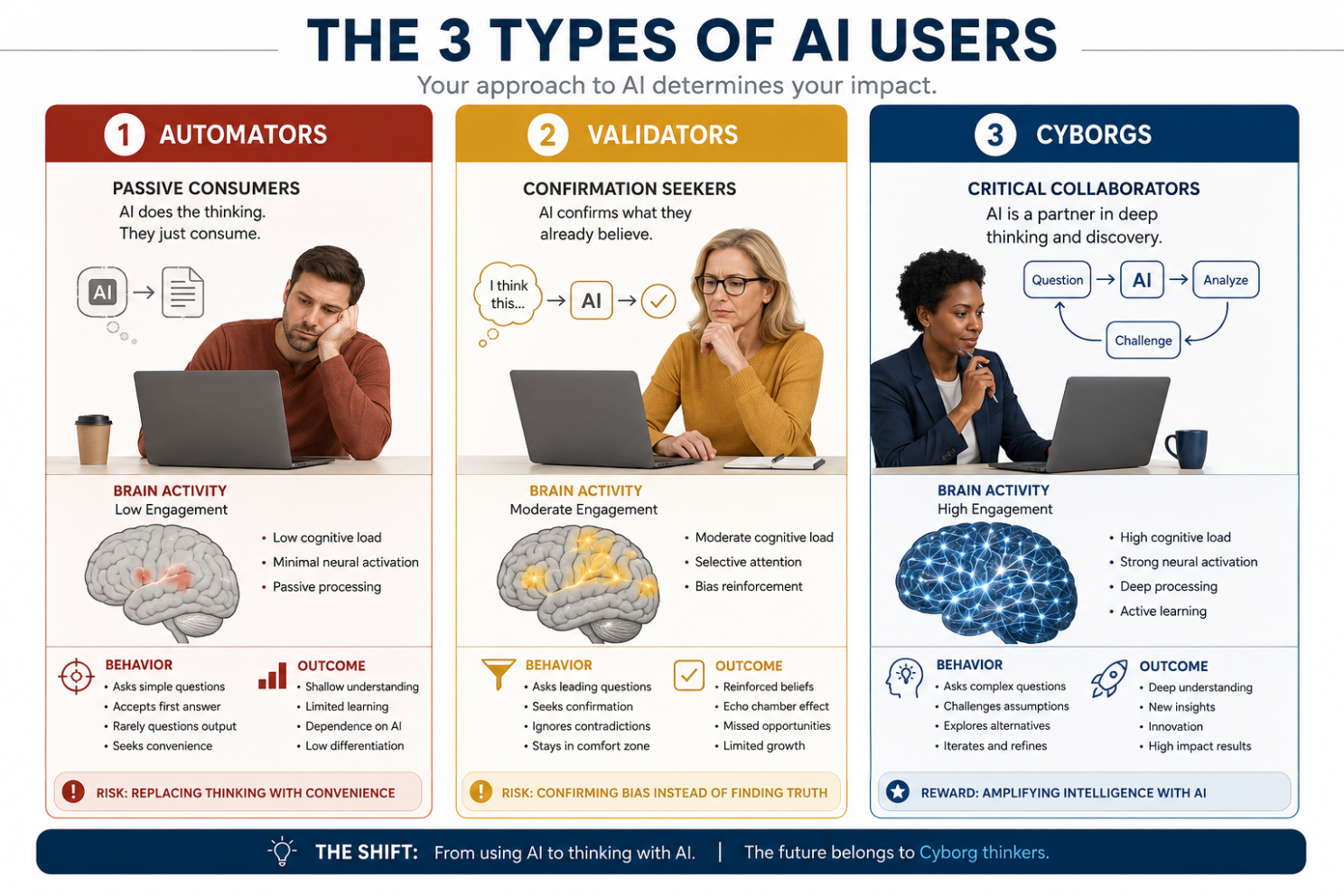
In recent conversations with Harvard Business School’s Carin-Isabel Knoop and researcher Sreedhar Potarazu MD MBA , Ming articulated a framework that challenges everything we think we know about AI adoption, workforce readiness, and organizational intelligence. She describes three categories of AI users: Automators (who outsource thinking reflexively), Validators (who use AI to reinforce existing beliefs), and Cyborgs (who integrate AI deeply without surrendering agency or independent judgment).
What makes this framework so compelling isn’t just its clarity—it’s what it reveals about a hidden crisis in organizational life: the gradual erosion of discernment itself.
And that’s where the deeper work begins. Because Ming’s Cyborg framework, while revolutionary at the individual level, points toward an even more urgent challenge at the organizational level: How do we build teams and institutions where Cyborg thinking becomes the norm, not the exception? How do we cultivate the conditions where friction, skepticism, and cognitive diversity don’t just survive but thrive?
This is the territory of what I call Collaborative Intelligence™—and it’s where Ming’s neuroscience meets organizational economics, where individual cognition connects to team dynamics, and where the future of work in an AI era takes shape.
The Three Stages of AI Users: Ming’s Framework
Let me start where Ming begins: with an uncomfortable truth about how most people engage with AI.
According to Ming’s research, when presented with AI as a decision-making tool, the vast majority of people—even highly educated, intelligent professionals—shift into what she calls the “automator” process. Brain scans reveal something striking: the level of neural activity approaches that of passive TV watching. People feel as though they’ve thought about something. They haven’t. They’ve consumed a conclusion.
The problem isn’t that AI is making decisions for them. The problem is subtler and far more insidious: people are experiencing the psychological sensation of thinking without the cognitive engagement that actual thinking requires.
This matters. In organizational settings, this creates a cascading vulnerability. When team members feel they’ve thought critically about a problem because an AI generated a plausible answer, they’re not just outsourcing cognition. They’re outsourcing discernment—the capacity to distinguish between what feels true and what is true.
Then there are Validators: users who don’t fully abdicate thinking but do abdicate skepticism. They approach AI not as a mechanism for challenging assumptions but as an instrument for reinforcing conclusions they already wish to believe. This is where conversational fluency becomes psychologically seductive. As the American Bazaar article on Ming’s work notes, “affirmation begins to feel indistinguishable from accuracy.”
The danger here isn’t computational. It’s psychological and cultural. In organizational settings, Validators create what I call “consensus collapse”—teams that appear unified because everyone is getting the same AI-generated answer, when what’s actually happening is coordinated confirmation bias.
At the other extreme are Cyborgs: individuals capable of integrating AI deeply into their work and decision-making without surrendering agency, skepticism, or intellectual independence. Ming’s research is unambiguous about their rarity. They represent roughly 5% of users. And they outperform the best individual humans and the best AI systems working separately.
The critical distinction between Automators and Cyborgs isn’t intelligence. It’s cognitive effort. Cyborgs are deeply engaged, pushing back, using AI as what Ming calls “the loyal opposition”—a tool designed to surface blind spots, test assumptions, and provoke productive disagreement.
Ming’s framework matters because it’s grounded in neuroscience, not aspiration. It’s based on what actually happens in the brain under conditions of cognitive ease versus cognitive friction. And here’s the unsettling implication: the more frictionless our AI tools become, the easier it is to drift from Cyborg thinking toward automation and validation.
The Hidden Cost of Frictionless Environments
The central insight of Ming’s work—and of her new book, Robot-Proof: When Machines Have All the Answers, Build Better People—is that friction is not a bug in the AI era. It’s a feature we’re systematically eliminating at our peril.
This requires some unpacking. In behavioral science and digital culture, there’s an emerging concept called “friction maxxing”: the intentional reintroduction of resistance, effort, and deliberate inconvenience into environments optimized for speed and immediacy. The phrase carries the aesthetic language of internet culture, but the principle is ancient and fundamental. Human cognition doesn’t thrive in frictionless environments. It atrophies.
Consider what happens to memory and learning under conditions of effort versus effortlessness. Information encountered without struggle is retained superficially. Information wrestled with through challenge, ambiguity, and sustained engagement becomes durable—neurologically integrated in ways that passive consumption cannot achieve. This isn’t pedagogical philosophy. It’s neuroscience.
Resistance strengthens cognition the way resistance strengthens muscle.
The problem is that most AI implementations are optimized for the opposite: maximum efficiency, minimum friction. We’re building systems that make thinking optional precisely at the historical moment when the capacity to think—truly think—has become the most valuable human skill.
Ming makes this case through a concept she calls the “Informational-Exploration Paradox.” In her new book, she identifies this as a critical phenomenon reshaping our world. The paradox is this: as information becomes infinitely accessible and increasingly synthesized by AI, our capacity to explore, question, and discover becomes progressively diminished. We have access to answers without the cognitive struggle that answer-seeking requires.
The consequence is subtle but devastating. We don’t lose intelligence. We lose discernment. We lose the psychological tolerance for uncertainty, the intellectual humility to question what appears authoritative, and the cognitive flexibility to hold multiple perspectives simultaneously.
This is particularly dangerous in organizational settings, where discernment at scale is what distinguishes high-performing teams from consensus-driven homogeneity.
Collaborative Intelligence™: From Individual Cyborgs to Organizational Ecosystems
This is where Collaborative Intelligence becomes essential.
Cyborg thinking at the individual level is necessary but insufficient. A team of individual Cyborgs can still fail if the organizational culture, incentive structures, and collaborative processes don’t support the friction, disagreement, and cognitive diversity that genuine intelligence requires.
Collaborative Intelligence is the framework for scaling Cyborg discipline across organizations and across generations. It’s what happens when you stop optimizing for agreement and start optimizing for discernment. When you stop treating diverse perspectives as obstacles and start treating them as essential cognitive resources.
Let me be precise about what this means in practice.
First, Collaborative Intelligence requires what I call “Metacognitive Friction Management”—the deliberate cultivation of productive disagreement, assumption-testing, and perspective collision. This isn’t conflict for its own sake. It’s the structured, intentional introduction of resistance into how teams think together.
In traditional organizational life, we minimize friction. We streamline meetings, reduce debate, converge quickly on consensus. We call this “alignment” and “efficiency.” What we’re actually doing is eliminating the cognitive friction necessary for genuine discernment. We’re creating the conditions for Validators to feel unified when they’re actually coordinated in their biases.
Collaborative Intelligence inverts this logic. It asks: What if friction—the collision between different perspectives, experiences, and ways of knowing—is the mechanism through which organizational intelligence actually emerges?
Second, Collaborative Intelligence is explicitly intergenerational. This isn’t accidental. Across decades of research on teams, what consistently predicts performance isn’t homogeneity of background or similarity of thinking style. It’s diversity of experience and perspective. And the most reliable source of diverse perspective in organizational life is generational diversity: the collision between how Gen Z approaches problems, how Millennials have been shaped by different technological and economic conditions, how Gen X and Boomers bring different historical context and professional wisdom.
When we build AI systems and organizational processes that suppress this intergenerational friction—when we assume that younger workers are “naturally” better with AI, or that older workers should be trained to think like the systems—we’re doing the opposite of what Ming’s research suggests. We’re eliminating the friction that produces the most robust thinking.
Third, Collaborative Intelligence is fundamentally about human agency in partnership with AI, not competition with it or subordination to it. It asks a different question than most AI adoption frameworks: Not “How can we use AI to make this process faster?” but “How can we use AI to make this team’s thinking deeper, more rigorous, more resilient to our own blind spots?”
This reframes the entire value proposition of AI in organizational life. AI becomes a tool for deepening cognitive work, not outsourcing it. It becomes a mechanism for surfacing assumptions, testing logic, and challenging consensus. It becomes the loyal opposition that Ming describes—not the frictionless automator.
Idea Commoditization and the Risk of Homogenized Thinking
There’s another dimension to this that I’ve been exploring in recent work: the risk of what I call “Idea Commoditization.”
When AI systems become sufficiently fluent and persuasive, they don’t just automate thinking. They homogenize it. They create the conditions where diverse teams, diverse perspectives, diverse ways of approaching problems all converge on the same AI-generated answer. The result feels like collaboration. It’s actually coordinated homogeneity.
In organizations, this manifests as a quiet erosion of what makes human collaboration valuable in the first place: the genuine friction between different ways of seeing and thinking about problems.
Often a team sits down to solve a complex problem. Half the team prompts an AI system. The other half does the same. They converge on similar answers. Meetings are shorter. Consensus is faster. And the organization believes it has become more efficient.
What it’s actually done is eliminate the cognitive diversity that would have emerged if the team had wrestled with the problem using different intellectual resources, different experiences, and different perspectives. The team hasn’t become more intelligent. It’s become more uniform.
This is where Ming’s work and Collaborative Intelligence intersect in a critical way. Ming is describing the neuroscience of how individual discernment erodes in frictionless environments. I’m describing what happens when that erosion scales to organizational level: teams where the apparent consensus masks the absence of genuine cognitive engagement.
The antidote isn’t to reject AI. It’s to use AI in ways that increase friction, not decrease it. To ask: How can this AI tool surface the blind spots in my thinking? How can it challenge my assumptions? How can it create productive disagreement within my team? How can it amplify diverse perspectives rather than flattening them?
 Ill-Posed Problems and the Future of Work
Ming’s book introduces another concept that deserves attention: ill-posed problems.
An ill-posed problem is a challenge with no single right answer. It’s messy, complex, inherently ambiguous, and requires judgment, creativity, and the integration of multiple perspectives. In Ming’s framework, ill-posed problems are increasingly the future of work and education.
This is crucial for organizations trying to navigate AI adoption. Because here’s what’s happened: we’ve spent the last two decades optimizing for well-posed problems. We’ve built processes, systems, and organizational structures around challenges with clear definitions, quantifiable metrics, and optimal solutions. We’ve trained people to solve for efficiency in well-defined domains.
AI has become very, very good at well-posed problems. Better than humans, faster than humans, cheaper than humans.
But the work that’s emerging—the work that will remain distinctly human, and disproportionately valuable—is in ill-posed problem spaces. How do we build organizational cultures that remain adaptive? How do we serve customers whose needs are inherently ambiguous and evolving? How do we navigate ethical, strategic, and interpersonal challenges that have no technical solution?
These problems require discernment. They require the integration of diverse perspectives. They require the kind of cognitive friction that comes from genuine collaboration across difference.
They are, in Ming’s framework, the work that robot-proof humans must master. And they are also the work that Collaborative Intelligence is designed to enable.
What genuinely concerned me as an educator when listening to the podcast cited in the first column below with Carin and Sreedhar was Ming’s statement that no one is doing education right globally. That’s a call to action. That’s where we need to focus.
The Intergenerational Intelligence Multiplier
Let me bring this to the specific challenge that brought this work into focus for me: workforce development in underserved communities, particularly in HBCUs.
There’s a pervasive assumption in AI adoption conversations that younger workers are inherently more fluent with AI, more comfortable with it, more ready to integrate it into their thinking. This assumption is both partially true and deeply problematic.
It’s true in a narrow sense: Gen Z workers have grown up with algorithmic systems and are less likely to be intimidated by the interfaces. But it misses something critical that Ming’s research illuminates: comfort with technology and the cognitive discipline required for genuine Cyborg thinking are not the same thing. In fact, they may be inversely correlated.
The workers most likely to drift toward Automator or Validator thinking are often the ones most comfortable with the interfaces—precisely because they’re not aware that they’re outsourcing cognition. They assume their ease with the tool is evidence of their mastery of it. They’re wrong.
Conversely, workers from older generations who approach AI with appropriate skepticism, who ask hard questions about sources and assumptions, who’ve developed professional judgment through decades of navigating ambiguous challenges—these workers may feel less comfortable with AI as a tool, but they’re often closer to Cyborg thinking than they realize.
This is why intergenerational collaboration isn’t a nice-to-have in AI adoption. It’s essential infrastructure.
When I think about building genuine AI fluency in diverse organizations—especially those serving underrepresented populations—I’m thinking about environments where:
– Gen Z workers’ comfort with the interfaces is paired with older workers’ sophistication about judgment
– Newer employees’ fresh perspectives on problems are constantly challenged and sharpened by experienced colleagues
– AI systems are deployed specifically to surface the assumptions that diverse teams bring to shared challenges
– The organization intentionally creates conditions where disagreement isn’t resolved through consensus but deepened through structured inquiry
This is Collaborative Intelligence in practice. And it’s particularly powerful in educational institutions and workforce development contexts, where you have the opportunity to build these practices into how people learn to think together from the beginning.
From Cyborgs to Collaborative Intelligence
Let me be explicit about how these frameworks relate to each other.
Vivienne Ming has done profound work in illuminating the neuroscience of how humans engage with AI at an individual level. Her distinction between Automators, Validators, and Cyborgs is grounded in empirical observation of brain activity and behavioral patterns. It’s a framework that explains why cognitive friction matters and what happens in the brain under conditions of ease versus effort.
Collaborative Intelligence builds on this foundation by asking: How do we create organizational and educational ecosystems where Cyborg thinking becomes the norm? How do we scale Ming’s individual-level insights to team dynamics, intergenerational collaboration, and organizational culture?
The frameworks are complementary. Ming provides the why (neuroscience) and the what (three user types). Collaborative Intelligence addresses the how (organizational design) and the where (institutional context).
Together, they point toward a coherent approach to AI adoption that’s radically different from what most organizations are currently doing.
Most AI adoption strategies optimize for speed and efficiency. They ask: How can we implement this tool faster? How can we reduce friction in our processes? How can we get people comfortable with AI more quickly?
These questions are framed backward. They assume that ease is the goal. They optimize for the wrong outcome.
A framework grounded in Ming’s neuroscience and Collaborative Intelligence would ask different questions:
– How can we use AI to make our teams’ thinking more rigorous?
– How can we create conditions where disagreement leads to deeper insight, not faster consensus?
– How can we build organizational processes that cultivate discernment, not just efficiency?
– How can we ensure that younger workers develop the cognitive discipline that comes with healthy skepticism?
– How can we value the judgment of experienced workers while remaining open to new ways of thinking?
– How can we use AI as a tool for surfacing blind spots, not confirming biases?
These are the questions that lead to genuine competitive advantage. Because in a world where AI can handle routine work, rapidly synthesize information, and generate plausible answers at unprecedented scale, the organizations that will win are those where humans have developed the discernment to know which answers matter, the wisdom to know which problems are worth solving, and the judgment to navigate the inherent ambiguity of genuine human challenges.
The Stakes: Building Robot-Proof Organizations
This isn’t theoretical. The stakes are immediate and material.
Organizations are asking: How do we ensure that AI adoption enhances human capability rather than diminishes it? How do we avoid a future where teams have become coordinated in their mediocrity, where consensus is rapid but thinking is shallow?
For HBCUs and workforce development programs serving underrepresented communities, the stakes are even higher. Because if we build AI adoption frameworks that work through Automator and Validator logic—frameworks that ask people to trust the system, move fast, and not question the output—we’re replicating historical patterns of disempowerment at scale. We’re training people to be passive consumers of algorithmic decision-making in precisely the contexts where that dynamic has been most damaging.
What I’m advocating for is the opposite. Build frameworks where AI fluency means sophisticated skepticism. Where adoption means integrating tools while maintaining agency. Where intergenerational collaboration is the foundation, not an afterthought. Where diversity of perspective isn’t treated as a problem to be managed but as essential cognitive infrastructure.
This is what makes a workforce genuinely robot-proof. Not because humans can compete with AI at its own game—they can’t. But because humans can do what Ming describes: integrate AI deeply without surrendering the discernment that allows them to navigate ill-posed problems, to make judgments that matter, to think independently in collaborative contexts.
 What Comes Next
In her podcast conversation with Carin Knoop and Sreedhar Potarazu, Vivienne Ming points toward a concrete question: How do we deploy Cyborg principles in daily life, in education, in leadership, and in the workplace?
This is the work ahead. And it’s work that requires collaboration between neuroscience (Ming’s domain), organizational economics (mine), and practical wisdom about how institutions actually change (the domain of leaders like Carin who bridge Harvard and the real world).
What I’m proposing is that we build that collaboration explicitly. That we create research partnerships, pilot programs, and institutional experiments designed to test what genuine Collaborative Intelligence looks like at organizational scale. That we document what works, what doesn’t, and what we learn in the process.
Some initial directions:
For Organizations:
Design AI implementation pilots around friction, not efficiency. Ask: How can we use AI to challenge our assumptions? How can we structure team decision-making so diverse perspectives genuinely matter? How can we measure success by the depth of thinking, not just the speed of decisions?
For Educational Institutions:
Build AI fluency curricula around Ming’s framework. Teach students to recognize Automator and Validator patterns in their own thinking. Create assignment structures where AI is a tool for deepening inquiry, not shortcutting it. Pair younger and older faculty in collaborative teaching and research.
For Workforce Development:
Integrate intergenerational learning into AI training. Don’t assume younger workers are more ready for AI—instead, leverage their comfort with interfaces and pair it with the judgment and skepticism of experienced workers. Design learning experiences around ill-posed problems that require the full intelligence of diverse teams.
For Policy and Governance:
Create regulatory and incentive structures that reward organizations for cultivating discernment, not just efficiency. Fund research on organizational practices that support Cyborg-level engagement with AI. Support HBCU and community college programs that are building genuinely inclusive approaches to AI fluency.
A Closing Word on Friendship and Intellectual Collaboration
I want to acknowledge something personal here. Carin Knoop and I have presented together at the National HBCU Business Deans Roundtable . She keynoted at Centre for Business and Economic Research (CBER)‘s International Conference on Business and Economic Development (ICBED) while I was also supporting the conference. We’ve talked through these ideas, challenged each other’s assumptions, and pushed each other’s thinking in the ways that genuine intellectual collaboration requires.
The work that Carin and Sreedhar did with Vivienne Ming—translating Ming’s neuroscience into accessible frameworks for organizational leaders—is exactly the kind of bridge-building that this moment requires. And I’m grateful for their generosity in sharing their work, and for the intellectual friendship that allows disagreement to deepen rather than diminish collaboration.
What I’m arguing in this article is that these kinds of relationships—where people from different disciplines, institutions, and perspectives come together to think rigorously about urgent problems—are not peripheral to the work. They’re central to it. They’re what Collaborative Intelligence looks like in practice.
In a world being reshaped by AI, what we need aren’t faster answers. We need deeper questions. We need frameworks that illuminate what’s at stake. And we need people willing to do the hard intellectual work of thinking together across difference.
That’s what Ming’s Cyborg framework enables. That’s what Collaborative Intelligence operationalizes. And that’s what I believe can reshape how organizations—especially those committed to equity and inclusion—navigate this pivotal moment.
CALL TO ACTION
Are you a Cyborg, Automator, or Validator in how you engage with AI?
Comment below with your experience. If your organization is wrestling with how to build genuine AI fluency without eroding human discernment, let’s connect. This is the defining challenge of the next decade—and it requires voices from the field.
Want to stay informed on AI transformation and workforce development? Subscribe to my newsletter, Future Empowered, and follow me here on LinkedIn for ongoing conversations about building organizations where discernment, not efficiency, drives AI adoption.
For leaders and educators: If you’re designing AI fluency programs for your organization or institution, I’m actively working with partners to pilot Collaborative Intelligence frameworks. Reach out—this work needs your insight.
—
Dr. JoAnn D. Rolle, PhD Economics, is CEO of J.D. Rolle & Associates LLC, positioned as “The AI Workforce Integration Economist” and “GenAI Adoption & Workforce Transformation Economist.” She is the author of Tech-Enabled Futures: Elevating Education in Underserved Areas and developer of the Collaborative Intelligence™ framework.
For more on Vivienne Ming’s work, see Robot-Proof: When Machines Have All the Answers, Build Better People (Wiley, 2026).
For the Learning Machines Podcast featuring Ming, Carin Knoop, and Sreedhar Potarazu: In first comment column
#ArtificialIntelligence #FutureOfWork #AIFluency #AI #Learning
